
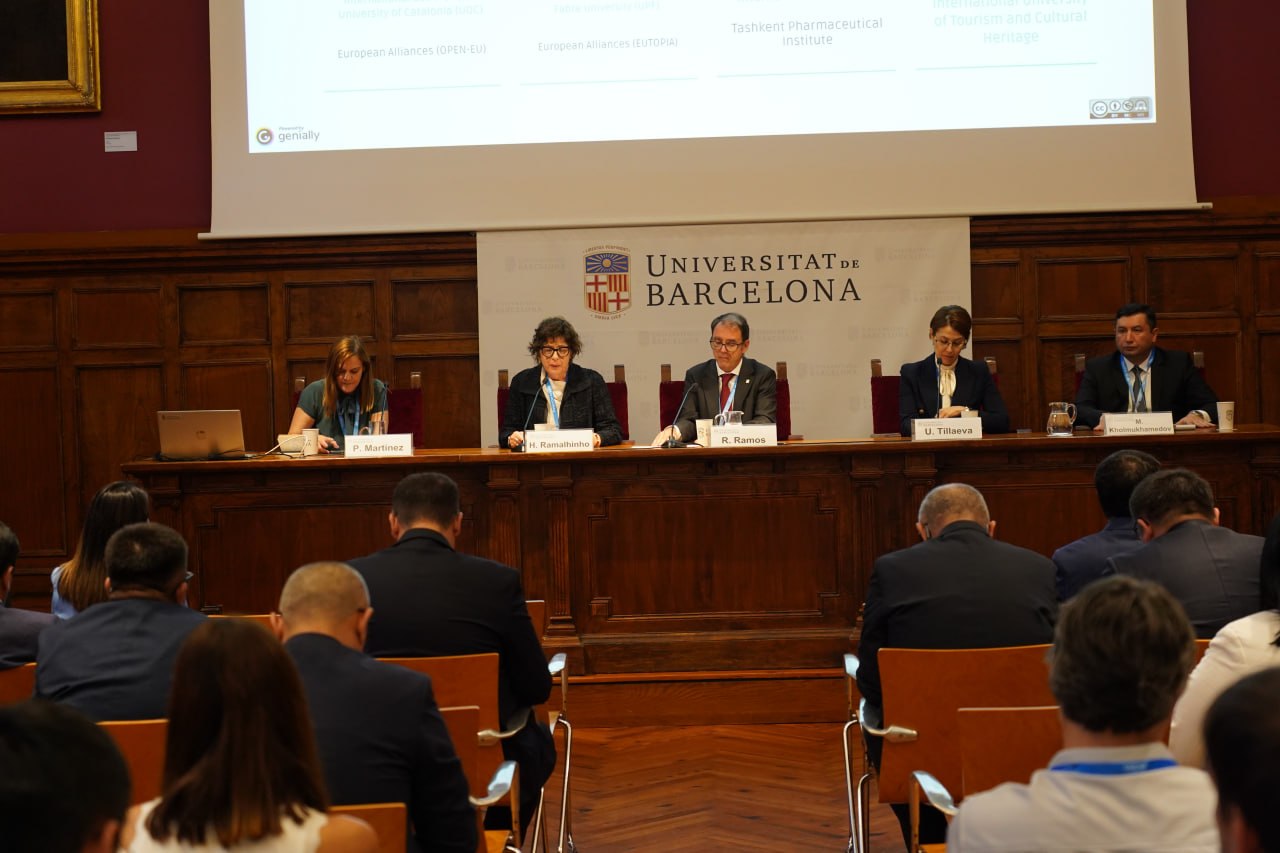
Uzbekistan–Spain University Forum Continues in Barcelona
Within the framework of the Uzbekistan–Spain University Forum taking place in Barcelona, Spain, the Rector of the university, Muhsinjon Xolmukhamedov, participated in a panel session dedicated to new strategies for international cooperation.
During the session, the Rector highlighted the following key points:
I. Updating the University's Development Strategy
The university is currently undertaking a comprehensive revision of its development strategy. One of the primary objectives is to establish effective cooperation with all stakeholders, including government institutions, regional authorities, and business representatives, while ensuring the university’s active participation in decision-making processes. Particular emphasis is being placed on the effective utilization of scientific and intellectual potential, research capacities, and the creation of social mobility opportunities for talented youth through collaboration with international partners, enabling them to advance from the local to the global level. Big Data and Artificial Intelligence technologies will play a significant role in achieving these goals.
The university is currently the first and only partner university of the United Nations Tourism Organization (UN Tourism). Close cooperation has been established in obtaining the TedQual international accreditation certificate, joining the International Network of Sustainable Tourism Observatories (INSTO), accessing the organization’s databases and digital library resources, and supporting the activities of the International Tourism Academy in Samarkand.
On June 11 of this year, several important agreements were reached with UN Tourism in new areas of cooperation:
Translation of UN Tourism’s AI-powered online learning platform into Uzbek to enhance the professional development of tourism specialists. This initiative will create educational opportunities not only for the population of Uzbekistan but also for residents of Central Asia and Turkic states, including young people and women living in remote areas. Assessment and certification mechanisms will also be introduced to promote employment and contribute to poverty reduction.
Development of video content and training courses for UN Tourism’s specialized platform based on the experience of Uzbek artisans. These courses will help increase young people’s interest in traditional crafts, support the training of young artisans, and promote Uzbek craftsmanship internationally.
Translation into Uzbek of key tourism-related publications and articles issued by UN Tourism.
Cooperation with UN Tourism in developing methodologies for teaching tourism-related subjects in preschool institutions, schools, and technical colleges across Uzbekistan.
II. Learning from Spain’s Tourism Experience
Tourism accounts for approximately 12 percent of Spain’s GDP, with more than 100 million international visitors annually, while around 13 percent of the country’s population is employed in the tourism sector. Uzbekistan aims to increase tourism’s share in GDP to 7 percent and attract 12 million tourists annually by 2030. In this regard, studying Spain’s advanced tourism experience and strengthening cooperation with UN Tourism, other international organizations, and Spanish universities remains a strategic priority.
III. International Student Mobility
Today, more than 150,000 Uzbek students are pursuing education abroad. According to UNESCO statistics, Uzbekistan ranks among the world’s leading countries in terms of international student mobility. This reflects the global outlook of Uzbek youth, their ability to adapt quickly to new environments, and their strong aspiration for quality education.
IV. AI-Based Educational Platform
In cooperation with UN Tourism, the university plans to develop a specialized Artificial Intelligence-based platform aimed at improving the qualifications of tourism professionals and strengthening tourism-related knowledge among young people. The platform will be built upon UN Tourism’s online courses and knowledge databases.
V. Establishing an International Research Center
A strategy is being developed to transform the university into an internationally recognized center for tourism, hospitality, cultural heritage, creative economy, and Silk Road studies in Central Asia. Important contributing factors include the tourism reforms initiated by the President of Uzbekistan, the launch of major projects such as the Imam Al-Bukhari Complex and the Center for Islamic Civilization, the construction of new railway routes, and the expansion of international air connections.
VI. Cooperation with Spanish Universities
Drawing upon the experience of Spanish universities, the university seeks to promote the concept of training specialists who value local and global social needs. Cooperation with Smart Tourism Laboratories operating at Spanish universities, as well as attracting tourism researchers and industry experts, is among the institution’s key priorities.
VII. Tourism Growth and Cultural Heritage Development
The President of Uzbekistan continues to promote an active peace-building policy in Central Asia. As a result, the number of foreign visitors to Uzbekistan has increased significantly in recent years, while tourism service exports have reached USD 3.5 billion.
Furthermore, the recognition of the Center for Islamic Civilization as one of the world’s largest museums dedicated to Islamic civilization, together with the large-scale reconstruction of the Imam Al-Bukhari Complex, which will be capable of serving up to 65,000 visitors per day, is further strengthening Uzbekistan’s pilgrimage and cultural tourism potential.
These developments provide a solid foundation for fully realizing the country's tourism opportunities and strengthening its position as a major tourism destination.